How to Choose a Car Removal Company in Adelaide
Every car removal company in Adelaide advertises the same four promises, which makes them impossible to tell apart until something goes wrong. Here's the checklist that separates a firm quote and clean paperwork from a revised offer in your driveway.
Why the Company You Choose Actually Matters
Search for car removal in Adelaide and you'll get pages of near-identical promises: top cash, free towing, same day, any condition. On the surface every operator offers the same thing, so most people just ring whoever appears first and take whatever number they're given.
That's how people end up several hundred dollars short. Offers for the same vehicle genuinely do vary between operators, and the gap is widest on exactly the cars people assume are worthless — non-runners, unregistered vehicles, older 4WDs. On top of the money, there's a second risk that rarely gets mentioned: if the transfer paperwork isn't completed properly, the vehicle stays legally connected to you after it leaves your driveway.
This guide is a practical checklist for choosing between Adelaide car removal companies. It covers the questions worth asking, the warning signs worth walking away from, how the quote is actually calculated, and what a good pickup day looks like. None of it takes long — twenty minutes of care usually pays for itself several times over.
How to Compare Adelaide Car Removal Companies
Work through these four steps in order. Together they take about half an hour and they'll surface both the best price and the operators to avoid.
Step 1 — Shortlist Three Operators
Pick three that service your suburb and have a real, findable presence: a registered business name, a physical address, and reviews that span more than the last fortnight. Ignore listings that are nothing but a mobile number and a stock photo.
Step 2 — Give Every Operator the Same Description
Year, make, model, variant, odometer, whether it runs, what's damaged, what's missing, and where it's parked. Identical inputs are the only way to get comparable quotes. Vary the story and you're comparing nothing.
Step 3 — Ask for a Firm Quote, Not a Range
"Somewhere between $400 and $900" is not a quote. Ask for one number, and ask whether it's guaranteed on arrival provided the car matches your description. Get it in writing or by SMS if you can.
Step 4 — Confirm What's Included
Towing, paperwork, and payment method should all be settled before you agree. Free means free: no call-out fee, no distance charge, no "admin" deduction at the kerb. Then take the best offer from an operator you're comfortable with — not necessarily the highest number on the list.
The Questions That Separate Good Operators From Bad
Every one of these takes ten seconds to ask, and the hesitation in the answer tells you as much as the answer itself.
"Is the quote guaranteed on arrival?"
The most common complaint in this industry is the revised offer: a strong quote on the phone, then a much lower figure once the truck is in the driveway and the car is halfway onto the tray. A confident operator will say yes without qualification, provided the vehicle matches what you described.
"Is towing genuinely free, to my address?"
Free removal is standard across Adelaide, but some operators quietly deduct a towing or distance fee for outer suburbs. Confirm the number you've been quoted is what lands in your hand.
"Who handles the transfer paperwork?"
A proper operator completes the disposal or transfer notice with you at collection and gives you a copy. Consumer & Business Services SA sets out your rights and obligations when dealing with traders, and the paperwork is what ends your responsibility for the vehicle.
"Where is the vehicle going?"
The answer should be a named yard or recycling facility that operates under SA EPA environmental requirements. An operator who can't say where your car ends up is a middleman at best.
"How and when am I paid?"
Payment should happen at collection — cash in hand or an instant transfer you can see land before the truck leaves. "We'll pay you once it's processed" is not an arrangement to accept.
Compare Our Offer Against Anyone Else's
Firm quote over the phone, free towing anywhere in Adelaide, payment on the spot, and the paperwork handled for you. No obligation to accept.
Call 0431 463 481 Get Online QuoteRed Flags and What Good Looks Like
Side by side, the difference between a professional operator and a chancer is easy to see.
| What You See | Established Operator | Warning Sign |
|---|---|---|
| The quote | One firm figure, guaranteed on arrival | Wide range, "assessed on the day" |
| Business details | Registered name, ABN, physical yard | Mobile number only, no address |
| Paperwork | Completed with you, copy provided | "Not needed for a car this old" |
| Payment | Cash or transfer at collection | Promised after processing |
| Towing | Included, no conditions | Fee appears at the kerb |
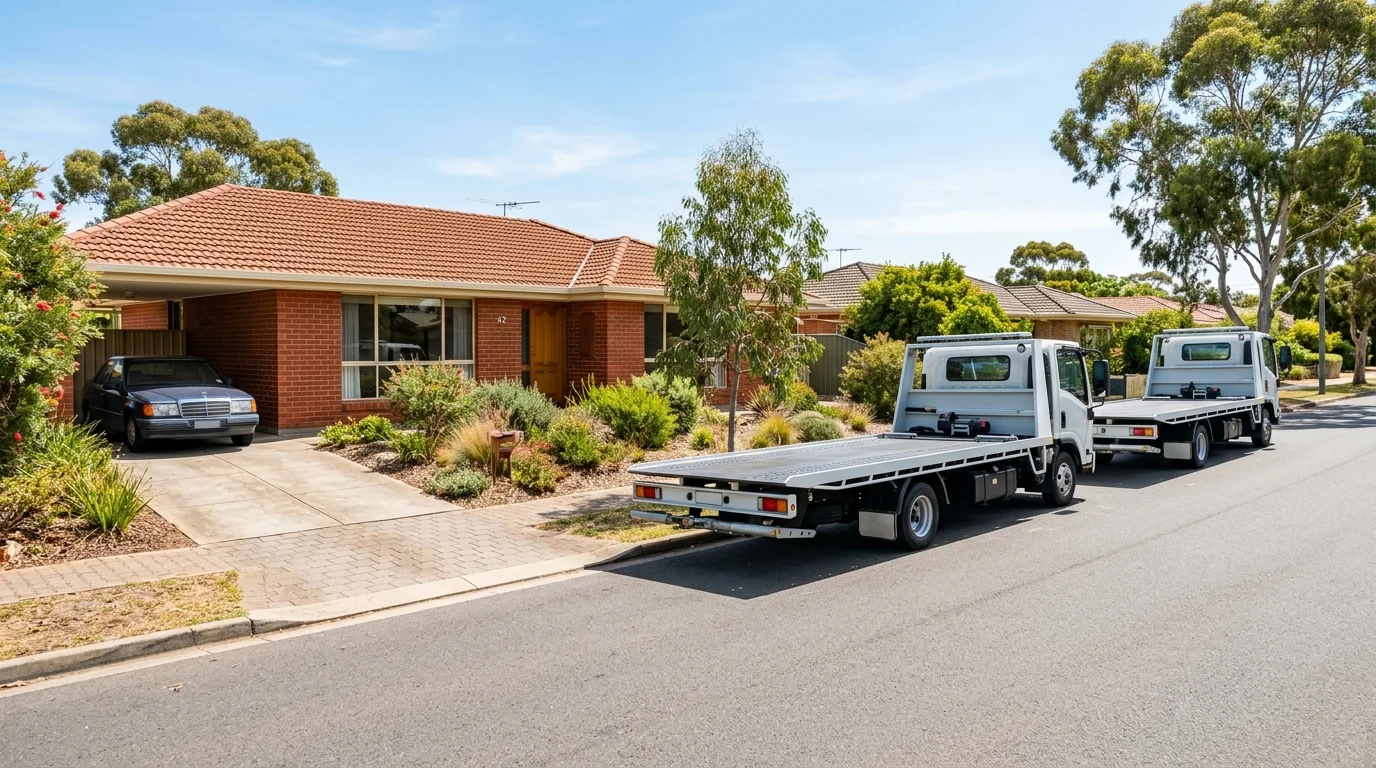
| Equipment | Marked, well-kept flatbed or tilt tray | Unmarked ute and a chain |
One more that catches people out: an offer dramatically above everyone else's is a warning sign, not a win. Vehicle values are set by weight, parts demand and metal prices, and no operator has a secret source of extra money. An outlier quote is usually the setup for a revision on the day.
How Your Quote Is Actually Calculated
Knowing what sits behind the number makes it obvious whether a quote is serious. Three inputs do almost all the work.
Weight and Metal Content
Steel sets the floor. A 2,400 kg ute has roughly twice the raw material of a 1,100 kg hatchback and opens at a correspondingly higher figure, regardless of condition.
Parts Demand for Your Model
This is where offers diverge for cars of similar weight. Commodores, Falcons, Hiluxes, Rangers, Camrys and Corollas move parts fast in Adelaide, so they carry a premium. Rare imports with no local parts market do not.
Condition and Completeness
A complete non-runner beats a partially stripped runner nearly every time, because the dismantler can recover everything. Fire, flood and severe collision damage push the offer back toward metal value alone.
Age and Residual Value
Depreciation research from Budget Direct puts typical Australian new-car depreciation at 40–60% in the first five years, and the curve keeps sliding. Somewhere past the ten-year mark the resale value and the removal value converge — that's the point where selling to a removal service stops being a compromise. Our complete guide to car removals in Adelaide covers that crossover in more detail.
What Coverage Should Look Like Across Adelaide
Any established Adelaide operator services the whole metropolitan area without charging for distance, but response times genuinely differ by region, and it's fair to ask what yours will be.
Northern suburbs owners around Salisbury, Elizabeth, Parafield and Golden Grove are closest to the main dismantling precinct, so same-day collection is routine. Eastern suburbs pickups around Norwood, Burnside and Campbelltown are straightforward, though narrow older streets and tight driveways mean it's worth flagging access when you book.
Southern and coastal owners near Marion, Morphett Vale, Hallett Cove and Brighton are a longer run from the yards, so aim to book earlier in the day. Adelaide Hills addresses around Stirling and Hahndorf need a truck suited to steep or unsealed access — again, say so when you call. If timing is the constraint rather than the price, ask specifically about same-day car removal rather than assuming it's on offer.
What a Good Pickup Day Looks Like
With the right operator, collection day is unremarkable — and that's the point. Here's what to expect, and what to have ready.
Before the truck arrives, clear the car out completely: glovebox, console, boot, under the seats, sun visors, and the spare wheel well. Anything left behind goes with the vehicle. Remove the number plates if the registration is still current, and have your proof of ownership and photo ID on the bonnet.
When the driver arrives, they'll walk around the vehicle and confirm it matches your description. Assuming it does, the quoted figure stands. You sign the transfer or disposal notice, you're paid on the spot, the car is winched onto the tray, and you keep a copy of everything. Fifteen to twenty minutes, start to finish.
Afterwards, lodge the disposal notice with Service SA if that hasn't already been handled for you, and cancel the registration and insurance if they're still active. That final step is what formally closes out your ownership — skip it and you can still be linked to the vehicle months later. If anything about the process is unclear, it's always worth a quick call to our Adelaide team before the truck is booked rather than after.
What Happens After the Truck Leaves
Most people stop thinking about the car the moment it's on the tray, but the back half of the process is where the difference between operators shows up most clearly — and it's the part you're implicitly endorsing when you pick a company.
A legitimate Adelaide operator takes the vehicle to a licensed dismantling yard, where it's depolluted before anything else happens. Fuel, engine oil, coolant, brake and transmission fluid, air-conditioning refrigerant and the battery are all drained and captured for licensed waste handling, and airbag units are made safe. Those materials are precisely why the SA EPA regulates this industry: a single car's fluids can contaminate a serious volume of groundwater if they end up on bare dirt behind a shed.
Once the vehicle is clean, parts recovery begins. Panels, drivetrain components, electronics, glass and interior trim with resale life are removed, tested and catalogued, and they go on to keep other Adelaide cars running at a fraction of new-part prices. Tyres are separated into the national recovery stream rather than landfill. The remaining shell — mostly steel — is baled, shredded, and fed back into Australian manufacturing. Roughly three quarters of a typical vehicle by weight is recovered this way.
An operator who won't name the destination yard is generally a broker passing your car to whoever bids, and at the bottom of that chain are people who take the valuable parts and abandon the rest. The vehicle is still linked to your name until the disposal notice is lodged, so an abandoned wreck can genuinely become your problem months later. Asking one question — "which yard does it go to?" — filters that risk out almost entirely.
None of this costs you anything. Environmental compliance is built into how a legitimate business already operates, and it does not come out of your offer. Choosing carefully gets you the better price and the cleaner outcome at the same time, which is an unusually easy decision to make.
Whether you end up choosing us or someone else, the pattern to look for is the same: a firm quote, genuinely free car removal, payment at collection, and paperwork done properly. Every reputable cash for cars operator in Adelaide can meet that bar. The ones that can't are telling you something worth listening to.
Frequently Asked Questions
How do I compare car removal quotes in Adelaide?
Give three operators the identical description — year, make, model, variant, odometer, condition and location — then ask each for one firm figure rather than a range. Identical inputs are the only way to get comparable quotes.
Should I always take the highest car removal quote?
Not automatically. An offer well above every other quote is often the setup for a lower 'revised' figure once the truck is in your driveway. Take the best offer from an operator who will guarantee the quote on arrival.
Is car removal in Adelaide really free?
With any established operator, yes — towing, collection and paperwork are all included, and the quoted figure is what you're paid. Confirm before booking that no call-out, distance or admin fee will be deducted at the kerb.
What paperwork do I need when my car is collected?
Proof of ownership and photo ID at collection, plus a completed transfer or disposal notice which you should keep a copy of. Cancel the registration and insurance afterwards to formally close out your ownership.
How long does car removal take in Adelaide?
Same-day collection is routine in the northern and western suburbs and common elsewhere in the metropolitan area. The pickup itself takes fifteen to twenty minutes from the driver arriving to payment in your hand.