How Much Is My Car Worth for Scrap in Adelaide? [2026 Price Guide]
The most common question we get is: 'how much is my car worth?' The honest answer depends on several factors — but Adelaide scrap car prices in 2026 typically range from $150 for a stripped shell to over $9,000 for a newer vehicle in reasonable condition.
What Determines a Scrap Car's Value in Adelaide?
When you call a car removal or scrap car service and ask what your vehicle is worth, the person on the other end is mentally running through four variables simultaneously: how much the vehicle weighs (and therefore its raw metal content), which parts can be recovered and sold, the overall condition of the vehicle and how complete it is, and the logistics of collecting it from your location.
These four factors don't operate in isolation — a heavy vehicle in terrible condition with a missing engine might fetch less than a lighter vehicle in average condition with all components intact. The calculation is always a composite, not a single-line formula. Understanding each factor helps you build a realistic picture of what your specific vehicle is worth and equips you to evaluate any offer you receive against the market.
It's also worth noting that the scrap car removal service market in Adelaide is competitive. There are multiple operators, and while their offers won't vary wildly for the same vehicle, calling two or three services to compare quotes is always a sensible approach before committing.
Factor 1 — Kerb Weight and Metal Content
Every scrap car has a floor value set by the metal it contains. A 950 kg Suzuki Swift simply cannot be worth as much in raw material as a 2,700 kg Landcruiser, regardless of condition. Weight is the first number any buyer works from, which is why utes, vans and 4WDs consistently open at higher figures than small hatchbacks.
Factor 2 — Recoverable Parts Demand
Above the metal floor sits parts value, and this is where offers diverge sharply for cars of identical weight. A Toyota Hilux and a lesser-known import of the same mass will not attract the same offer, because one has an active Adelaide parts market and the other does not. Popular Australian models carry a real premium here.
Factor 3 — Completeness and Condition
Buyers price the vehicle as a package. A complete non-runner is worth more than a partially stripped runner, because the dismantler can recover everything rather than discovering gaps on arrival. Fire, flood and severe collision damage pull the offer back toward pure metal value.
Factor 4 — Collection Logistics
Where the car sits and how easily a tow truck can reach it has a modest but real effect on the number. A vehicle on a flat driveway in Salisbury is cheaper to collect than one wedged in a narrow rear garage up in the hills. Most reputable operators absorb this cost rather than passing it on, but extreme access problems can shave the offer.
Adelaide Scrap Car Price Guide by Vehicle Type
The table below provides 2026 estimates for Adelaide scrap car prices by vehicle type. These ranges represent typical offers for vehicles in average condition — meaning the vehicle is complete (all major parts present), not recently stripped, and in the condition you'd expect from a car that's been driven and not extensively restored.
| Vehicle Type | Weight (approx.) | Scrap Price Range 2026 |
|---|---|---|
| Small hatchback (Toyota Yaris, Suzuki Swift) | 900–1,100 kg | $150 – $800 |
| Mid-size sedan (Toyota Camry, Mazda 3) | 1,200–1,500 kg | $300 – $1,800 |
| Large sedan/wagon (Holden Commodore, Ford Falcon) | 1,500–1,800 kg | $400 – $2,500 |
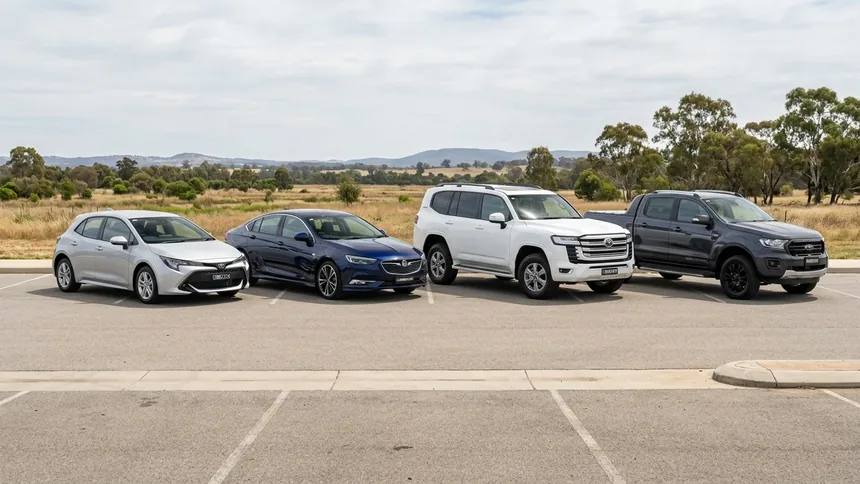
| SUV/4WD (Toyota Landcruiser, Nissan Patrol) | 2,000–3,200 kg | $800 – $5,000+ |
| Ute (Ford Ranger, Toyota Hilux) | 1,800–2,400 kg | $600 – $4,500 |
| Van (Toyota HiAce) | 1,700–2,300 kg | $500 – $3,000 |
| Truck (light commercial) | 3,000–8,000+ kg | $1,500 – $9,000+ |
These are ranges, not guarantees. A Toyota Landcruiser with a seized engine and a stripped interior will sit toward the lower end of that SUV/4WD range. The same model in non-running but complete condition, with all body panels and interior intact, will sit considerably higher. The year of manufacture also matters — a 2010 Landcruiser 200 Series has significantly more parts demand than a 1995 80 Series.
For Holden Commodores and Ford Falcons — the iconic Australian large cars — the strong local ownership base has maintained reasonable parts demand even as production has ended. These vehicles represent particularly good scrap value relative to their weight because the parts market remains active.
Age matters in a second, less obvious way: the older the car, the smaller the gap between its scrap value and its resale value. Budget Direct's car depreciation research puts typical Australian new-car depreciation at roughly 40–60% across the first five years, and the curve keeps falling after that. By year fifteen, most vehicles are worth close to what a dismantler will pay — which is exactly the point at which scrapping stops being a loss and starts being the sensible option.
Get an Accurate Quote for Your Vehicle
The table above gives estimates. For a precise offer on your specific car, call us directly — we'll give you a firm price in minutes.
Call 0431 463 481 Get Online QuoteThe Role of Scrap Metal Prices
At the most fundamental level, a car is a collection of metals. The body, chassis, and most mechanical components are steel. The cylinder head, alloy wheels, and various transmission housings are typically aluminium. The catalytic converter contains precious metals — primarily platinum, palladium, and rhodium — that are genuinely valuable in their own right.
Steel scrap prices in Australia are quoted in dollars per tonne and fluctuate with global commodity markets, influenced by factors including Chinese industrial demand, shipping costs, and domestic supply. In 2026, Australian scrap steel prices have been hovering around $180–$250 per tonne, depending on grade and purity. An average passenger car contains approximately 600–900 kg of steel, meaning the steel content alone is worth $100–$200 at current rates.
Aluminium scrap commands significantly higher prices — roughly $900–$1,200 per tonne. Alloy wheels, cylinder heads, and aluminium engine blocks contribute meaningfully to the total metal value of larger vehicles. This is one reason why aluminium-intensive vehicles like some European makes can command better scrap prices than their weight alone would suggest.
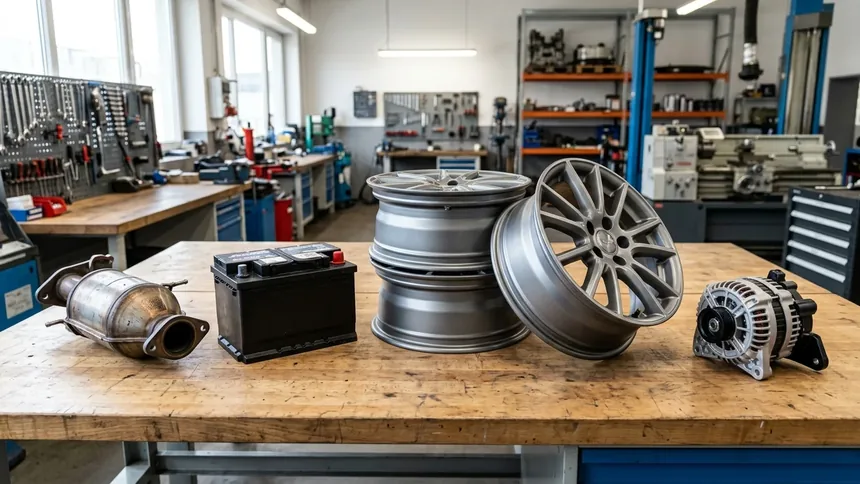
The catalytic converter deserves special mention. Modern converters contain between 3 and 7 grams of platinum group metals (PGMs) — platinum, palladium, and rhodium — all of which are trading at significant prices. The ATO's effective life guidance acknowledges that catalytic converters depreciate over time, but their commodity value often remains substantial. This is why catalytic converter theft is prevalent — and also why having your converter intact significantly improves your scrap car offer. A car with a missing converter will receive a noticeably lower quote.
High-Value Parts That Boost Your Offer
While the metal content provides the floor value, it's the recoverable components that often determine where in the price range your vehicle lands. Here are the parts that contribute most to a higher cash offer.
Catalytic Converter
As discussed, the catalytic converter is one of the most valuable individual components on any modern vehicle. Even in a car where everything else has deteriorated, a working catalytic converter adds meaningful value to your offer. If yours has been stolen (a common occurrence in certain areas), disclose this when calling for a quote — it will affect the number, and it's better to know upfront than to have the offer revised at pickup.
Engine & Transmission
A complete, identifiable engine is worth considerably more than an engine that's been stripped or damaged beyond identification. Even a non-running engine from a popular vehicle like a Toyota Camry or Ford Ranger has parts demand — injectors, sensors, alternators, starters, and many smaller components can be refurbished and resold. An intact transmission is similarly valuable. Together, a working powertrain can represent a substantial premium over baseline scrap value, particularly for popular models.
Wheels & Tyres
Factory alloy wheels in reasonable cosmetic condition can be worth $50–$200 per wheel on the used parts market. If your vehicle still has its original alloys and they're not heavily kerbed or cracked, they contribute real value to your offer. Standard steel wheels have minimal value beyond scrap, but alloys from popular vehicles (especially 4WDs and utes) are consistently in demand. The tyres themselves rarely add to the offer, but leaving them fitted saves the buyer a disposal step.
Electronics & ECU
Modern vehicles contain dozens of electronic control units, sensors, and modules. The main ECU (engine control unit) is the most valuable single electronic component, particularly for vehicles where the ECU is not easily reprogrammable — some manufacturers use coded systems that make second-hand ECUs difficult to swap. Body control modules, ABS units, and airbag controllers are also useful to parts recyclers. Keeping these intact rather than stripping them for resale yourself generally results in a better overall offer.
Condition Categories and What They Mean for Your Payout
When you describe your vehicle to a removal service, they're mentally categorising it into one of several condition tiers. Understanding these tiers helps you communicate accurately and set appropriate expectations.
| Condition | Description | Price Impact |
|---|---|---|
| Running, complete | Vehicle starts and drives, all major parts present | Top of range — maximum offer |
| Non-running, complete | Vehicle doesn't start but all components intact | Good offer — parts recoverable |
| Non-running, partially stripped | Some parts removed (battery, wheels, etc.) | Moderate — reduced by missing parts |
| Accident damaged | Collision damage, airbags may have deployed | Lower, but still valuable for metal/parts |
| Fire or flood damaged | Severe damage to interior and/or mechanical | Minimum range — metal value primarily |
A vehicle described as "non-running, complete" often surprises owners with a better offer than expected. The reason is that removal services are buying the whole vehicle, not just what they can see runs. A non-running Hilux with a seized engine is still a complete Hilux — with suspension components, a diff, a gearbox, body panels, interior trim, electrical systems, and wheels that all have parts demand. The engine itself might even be rebuildable, adding further value.
If your vehicle sits in the bottom two tiers, don't assume it's worthless. Our damaged car buying service handles collision, hail, fire and flood vehicles every week, and even a burnt-out shell still carries its metal value plus whatever survived intact underneath.
Scrap Car Valuations Across Adelaide
Where you are in Adelaide doesn't change what your car is made of, but it does change how quickly someone can get to you — and a buyer who can collect today will usually quote more confidently than one scheduling a week out. We quote and collect right across the metropolitan area, seven days a week.
In the north we're regularly working through car removal in Elizabeth and the surrounding Playford council area, where older Commodores and Falcons still make up a large share of the vehicles we buy. Salisbury and Parafield sit on the same run, so northern pickups are very often same-day.
South and along the coast, scrap car pickup in Marion and the Morphett Vale corridor sees a steady mix of family SUVs and small hatchbacks. Eastern suburbs owners around Norwood and Burnside tend to have newer, higher-value vehicles where parts demand rather than weight sets the price. Out west, Port Adelaide and West Lakes are closest to our Cavan yard, which makes for the fastest turnaround anywhere on the network.
How to Get the Best Scrap Car Price in Adelaide
Getting the maximum payout for your scrap car in Adelaide comes down to a handful of straightforward actions that most people don't take the time to do.
1. Call Multiple Buyers
This is the single most effective action you can take. Prices vary between operators, and spending fifteen minutes calling three services can result in meaningfully different offers. Don't just go with the first quote you receive — and don't feel awkward saying you're shopping around, because every buyer in this trade expects it.
2. Describe the Vehicle Accurately and Completely
Mention the year, make, model, odometer reading, whether it runs, and importantly — what parts are still present. Highlighting that the catalytic converter is intact, the alloy wheels are in good condition, or the engine is complete gives the buyer useful information that may be reflected in a higher offer. Vague descriptions get conservative quotes.
3. Don't Strip the Vehicle Beforehand
Keeping everything intact gives the buyer more to work with and usually results in a higher total offer than you'd achieve by selling parts individually. The one exception is genuinely personal property — clear the glovebox, boot and under the seats, because anything left in the car leaves with it.
4. Get a Firm Quote Before the Driver Arrives
A reputable service will stand behind the quote they give you over the phone. If a company is vague about the offer or says they'll "assess on arrival," that's a sign the quoted amount may be revised downward once they have you in front of them. Consumer & Business Services SA publishes guidance on your rights when dealing with traders, and a written or confirmed verbal quote is your simplest protection.
5. Time It Right
If your vehicle is a common model with active parts demand, a buyer who is currently short on inventory for that model may offer more. This is harder to predict, but demand for specific models genuinely does move offers — another reason calling multiple services is worthwhile. Scrap steel prices also drift over the year, so if you're not in a hurry, a second round of quotes a month later costs you nothing.

Scrap Car Removal vs. Selling to a Wrecker — What's the Difference?
A wrecker (also called an auto dismantler or wrecking yard) and a car removal service are closely related — in fact, many removal services are operated by or affiliated with wrecking yards. The key difference is in the transaction model.
| Feature | Car Removal Service | Drive-In Wrecker |
|---|---|---|
| Transport | Free towing — they come to you | You deliver, or you pay for a tow |
| Non-running vehicles | Accepted as standard | Often a problem |
| Quote timing | Over the phone, before pickup | On arrival, after you've moved it |
| Payment | On the spot at collection | On the spot at the yard |
| Paperwork | Handled for you | Usually handled for you |
When you take a car to a wrecker, you generally need to deliver it yourself (or arrange transport), and the wrecker will assess it in person and make an offer. There's no cash-for-cars removal service included — you're transporting the vehicle to them. This can work well if your vehicle still runs and you want to negotiate in person while comparing what's on the lot.
A cash for cars removal service, by contrast, comes to you. They handle all transport logistics at no cost, pay you on pickup, and process the transfer paperwork. For non-running vehicles or for those who simply want the most convenient option, removal services are the practical choice. The offers are generally comparable, and the added convenience is substantial.
For junk cars — vehicles that are clearly end-of-life — a removal service is almost always the better choice. There's no point paying for transport to a wrecker when you can have the vehicle collected for free and receive payment at the same time. If free collection is the part you're most interested in, our guide to how free car removal works in Adelaide walks through the whole process end to end.
What Happens to Your Car After Collection
Once your vehicle leaves the driveway it goes through a regulated depollution and dismantling process, and understanding that process explains why complete cars are worth more than stripped ones.
The first step is depollution: fuel, engine oil, coolant, brake fluid, transmission fluid, refrigerant gas and the battery are all drained and captured. This is not optional. Licensed operators in South Australia handle these materials under SA EPA environmental requirements, and it is the clearest single difference between a legitimate business and a backyard operator who will tow your car for cash and then deal with the waste however suits them.
Next comes parts recovery — panels, drivetrain, electronics and interior components that still have resale life are removed, tested and catalogued. Tyres are separated and enter the national recovery stream managed by Tyre Stewardship Australia rather than going to landfill. What remains — the shell — is crushed and shredded, and the steel goes back into Australian manufacturing.
The end result is that roughly 75–80% of a typical vehicle by weight is recovered and reused. That recovery rate is exactly what funds your cash offer, and it's why our car recycling service can pay you for a vehicle you'd otherwise be paying someone to take away.
Frequently Asked Questions
What is the minimum payout for a scrap car in Adelaide?
The minimum payout for a scrap car in Adelaide is typically around $150–$300 for a heavily stripped or very small vehicle. Most standard cars fetch $300–$2,000 depending on weight and parts value.
Does my car need to be running to get a good price?
No. Non-running vehicles are accepted and still receive competitive cash offers. The value is primarily based on weight, parts, and metal content — not whether the engine starts.
How do scrap metal prices affect my car's value?
Scrap metal (primarily steel and aluminium) makes up a significant portion of your car's value. Prices fluctuate with global commodity markets. We monitor current rates and pass on fair value to you.
Can I increase my car's scrap value before selling?
Yes. Keeping all major components intact (engine, transmission, catalytic converter, battery) generally increases your offer. Removing parts before calling usually lowers the quote.
How quickly will I receive payment?
Payment is made on the spot at time of pickup — cash in hand or instant bank transfer, whichever you prefer. There is no waiting period.